Image Source: pexels
You have many choices when you run building projects worldwide. Companies like Sibolla Building use B2B platforms to gather all needed materials. This works for both centralized and decentralized procurement. Good procurement helps you stop high costs, delays, and supply chain problems. The table below explains why procurement efficiency is important in construction:
| KPI | Description |
|---|---|
| Cost per Purchase Order | How much it costs to handle one order. |
| Purchase Order Cycle Time | How fast you go from asking to getting delivery. |
| Supplier Defect Rate | The quality of the materials you get. |
| Total Cost to Procure | All costs, like price, paperwork, shipping, and quality. |
Centralized vs. Decentralized Procurement is important for your project’s success. Think about how you do things now. Could a one-stop solution help you save time and money?
Key Takeaways
- Centralized procurement helps control spending and makes rules clear for everyone. Decentralized procurement lets local teams move fast and make friends with suppliers. B2B platforms make buying things easier by putting teams and suppliers together. Real-time data lets you watch materials and fix problems early. Standardization and automation stop mistakes and help save time when buying things. Picking the best procurement model depends on your project’s size and needs. A hybrid model mixes the good parts of centralized and decentralized ways. Sibolla Building gives you one place to get materials, so you save time and make fewer mistakes.
B2B Platforms and Bill of Materials Consolidation
Image Source: pexels
Digital Integration in Procurement
Digital integration makes procurement much simpler. B2B platforms bring your teams, suppliers, and systems together. This helps you find and order materials fast. You do not need to use many tools or call lots of suppliers. Everything you need is on one screen.
Here is a table that shows how digital integration helps multinational construction firms with procurement:
| Benefit | Description |
|---|---|
| Streamlined Purchasing | Digital tools make it easier to search and ask for materials, making buying smoother. |
| Improved Inventory Management | Lets you track materials in real time, so you can control stock better. |
| Enhanced Communication | Helps field and office teams talk better, so there are fewer mistakes. |
| Efficient Invoice Reconciliation | Matches invoices, purchase orders, and deliveries automatically, so there are fewer errors. |
| Integration with ERP Systems | Connects with your other systems for better project and cost control. |
| Centralized Application | Puts all procurement tasks in one place, so the process is easier. |
When you use a B2B platform, you can connect procurement with your company’s ERP system. This helps you control costs and schedules better. The system checks your orders and invoices, so you make fewer mistakes.
Real-Time Data and Visibility
You need to know what is happening with your materials all the time. Real-time data gives you this power. You can track orders, see where shipments are, and check how suppliers are doing. This helps you stop delays and fix problems early.
- Real-time data lets you see inventory and supplier performance all the time.
- You can act fast if there are delays or problems, which helps you work better with suppliers.
- You can guess future needs from current data, so you buy smarter and manage inventory better.
With real-time data, you do not have to guess. You can make choices using facts. This matters when you look at Centralized vs. Decentralized Procurement. Both models need good data, but you might use it in different ways.
Standardization and Automation
Standardization means you follow the same steps every time you buy materials. Automation means the system does some jobs for you. B2B platforms help you set rules for buying, tracking, and paying for materials. This saves time and cuts down on mistakes.
Tip: When you standardize procurement, it is easier to train new team members and keep projects on track.
Automation can send purchase orders, check invoices, and update inventory for you. You do not have to do these jobs by hand. This lets you spend more time on big decisions and project goals.
Using B2B platforms for procurement gives you better control, faster results, and fewer mistakes. You can use both centralized and decentralized models with more confidence.
Centralized vs. Decentralized Procurement Models

Image Source: unsplash
Centralized Procurement Overview
Centralized procurement means one main office does all the buying. This gives you strong control over every project. You make rules for how teams buy materials. You keep track of spending in one place. You can make deals with suppliers for lower prices. You stop teams from buying the same thing twice. You make sure everyone follows company rules.
Centralized procurement helps you:
- Make sure everyone follows the same rules.
- Get lower prices from suppliers.
- Watch spending easily.
- Stop mistakes and buying things twice.
Note: Centralized procurement is good for big projects. You need strong control and clear records.
Decentralized Procurement Overview
Decentralized procurement lets each team buy what they need. Local teams can make their own choices. They can act fast when things change. They know what their project needs. This model gives you more freedom. You can work with many suppliers. You can fix problems quickly.
Decentralized procurement helps you:
- Act fast when local needs change.
- Build good relationships with local suppliers.
- Make choices quickly.
- Change plans when the project changes.
Tip: Decentralized procurement is best for projects in many places or with special needs.
Comparing Strengths and Weaknesses
You must pick centralized or decentralized procurement for your project. Each model has good and bad points. You need to think about control, freedom, and risk.
Here is a table that shows how the two models compare:
| Aspect | Centralized procurement | Decentralized procurement |
|---|---|---|
| Compliance and control | Easier to enforce company-wide compliance and procurement policies. | Harder to ensure consistent adherence to policies across all units. |
| Risk of duplication | Lower; centralized oversight reduces the chance of duplicate purchases. | Higher; independent purchasing can lead to redundant acquisitions. |
| Spend visibility and control | High; centralized data allows for better tracking and control of expenditures. | Low; dispersed data can make it challenging to monitor overall spending. |
| Flexibility and responsiveness | Less flexible; may be slower to respond to specific departmental needs. | More agile; departments can quickly address their unique requirements. |
| Improved risk management | Easier to conduct risk assessment and mitigation strategies across the organization. | Local teams manage supplier interactions; may lead to diverse supplier base. |
Centralized procurement gives you strong control and better risk management. You can watch spending and make sure rules are followed. Decentralized procurement gives you more freedom. You can act fast and build good supplier relationships. You need to balance control and freedom.
Centralized vs. Decentralized Procurement is an important choice. You must pick the model that fits your goals. B2B platforms can help with both models. These tools help you track spending, manage suppliers, and lower risks. You can use both models together for better results.
Callout: Think about your project size, where it is, and what you need. Pick the model that helps you save money, lower risks, and finish on time.
Sibolla Building’s Integrated Procurement Approach
One-Stop Material Solutions
You want your project to run smoothly from start to finish. Sibolla Building gives you a one-stop solution for all your building material needs. You do not have to manage many suppliers or worry about missing items. You get everything you need for your project in one place. This approach saves you time and helps you avoid mistakes.
When you use Sibolla Building, you work with a team that understands your project. You get help with planning, design, and material selection. You see how all the pieces fit together before anything ships. You do not have to chase down different vendors or solve problems alone. You have one point of contact for questions and updates.
Tip: A one-stop solution means you spend less time on paperwork and more time building.
Direct Factory Access and Cost Control
You want to control your budget and keep costs low. Sibolla Building connects you directly to factories. You do not pay extra for middlemen or agents. You get clear prices and know where your money goes. This helps you plan your spending and avoid surprises.
Direct factory access means you get materials made for your project. You can ask for custom sizes, finishes, or features. You do not have to settle for what is in stock at a store. You get what you need, when you need it.
You also get better quality control. Sibolla Building checks every order before it ships. You know your materials will match your plans. You do not have to worry about delays from missing or wrong items.
Project Coordination and Risk Reduction
You want your project to stay on schedule and avoid risks. Sibolla Building uses integrated logistics to manage every step. You see where your materials are at all times. You get updates on shipping, delivery, and installation support.
Integrated logistics makes your project run better. You get better demand forecasting and inventory management. You do not wait for missing parts or guess when things will arrive. You can plan your work and keep your team moving.
Sibolla Building gives you a single point of accountability. If you have a question or a problem, you know who to call. You do not have to sort out issues between many suppliers. This reduces your risk and helps you finish your project on time.
Note: Integrated logistics helps you work with less stress and more confidence.
When you compare Centralized vs. Decentralized Procurement, you see that Sibolla Building’s approach supports both models. You get the control of a centralized system and the flexibility to meet local needs. You can choose the best way to manage your project and know you have support at every step.
Centralized vs. Decentralized Procurement in Practice
Implementation with B2B Platforms
You can use B2B platforms to make buying easier. These platforms bring all your vendors and teams together. You can follow some steps to set up centralized or decentralized procurement with a B2B platform:
- Make a self-service portal for vendors. Suppliers can register and upload catalogs fast.
- Connect your B2B platform to your current procurement software. Use punchout catalogs or APIs to make ordering easy.
- Use collaboration tools like shared carts and order comments. Buying teams can work together and stay updated.
You also need to think about logistics, compliance, and payments. Make sure your platform can handle orders from many vendors. Set rules so everyone follows company policies. Offer different payment options for your project needs. Good data matters, so use tools that keep your information clean and simple.
B2B platforms help you save time and cut mistakes. They automate tasks and give you better control over orders. You can track everything in real time, which helps you plan and avoid delays.
Hybrid Models for Global Projects
Many big construction firms use both centralized and decentralized procurement. This is called a hybrid model. It gives you the best parts of each way. You get strong control from a central team, but local teams can make quick choices when needed.
| Key Aspects | Description |
|---|---|
| Definition | A hybrid procurement model blends centralized and decentralized approaches. |
| Advantages | – Balanced control and responsiveness: Central teams drive standard contracts; local teams handle urgent sourcing.- Optimized cost and flexibility: Central units negotiate large contracts; local units avoid bottlenecks.- Improved site ownership: Local teams feel empowered while benefiting from central resources. |
| Disadvantages | – Complex governance: Requires clearly defined decision rights and workflows.- Risk of role confusion: Can lead to inefficiencies if not managed properly.- Integration challenges: Demands robust platforms for handling distributed purchases. |
| Fit for Industry | Most suitable for mid-to-large enterprises with multiple sites needing both common and unique solutions. |
A hybrid model works well for global projects. Central teams set up big contracts and make sure everyone follows the same rules. Local teams can buy what they need fast, so projects do not slow down. This model helps you balance control and flexibility.
Sibolla Building Case Example
Sibolla Building uses B2B platforms for both centralized and decentralized procurement. For example, in a hotel project, the central office made contracts for key materials like doors, tiles, and lighting. Local teams used the platform to order extra items when site needs changed. This helped the project stay on schedule and within budget.
B2B platforms made the process simple. The sales cycle moved faster, so the project started sooner. Automated tasks reduced paperwork and made it easier to manage many suppliers. The platform gave everyone a clear view of orders and deliveries. Teams could track shipments and fix problems before they caused delays.
You can see how this approach makes things less complicated. It helps you manage projects in different countries and keeps everyone working together. Centralized vs. Decentralized Procurement does not have to be one or the other. With the right tools, you can use both models and get better results for your projects.
Optimizing Procurement with Sibolla Building
Assessing Project Needs
You should first figure out what your project needs. Every construction project is not the same. You have to check your materials, schedule, and budget. The table below lists important things to think about:
| Criteria | Description |
|---|---|
| Project-Specific Requirements | Materials must match your designs, local codes, and site needs. |
| Dynamic Construction Schedules | Weather, permits, or changes can affect your timeline. |
| Storage and Site Logistics | Limited space means you must plan deliveries carefully. |
| Budget Overruns | Watch for cost changes and plan for surprises. |
| Cash Flow Limitations | Manage payments and project timing to avoid cash problems. |
You can use these things to check how you do things now. This helps you find problems and plan better for your next project.
Selecting the Right Model
You need to pick a procurement model that fits your project. Centralized and decentralized models both have good points. The table below shows how they are different:
| Factor | Centralized Model | Decentralized Model |
|---|---|---|
| Control | One team manages for consistency | Local teams manage for flexibility |
| Regional Considerations | Follows global standards | Meets local needs and rules |
| Talent and Team Capabilities | Uses experts and category managers | Needs diverse skills in each team |
| Technology Enablement | Uses one system for all teams | Local systems may differ |
| Transactional Support Needs | Handles routine tasks centrally | Local teams handle their own tasks |
Think about your project’s size, where it is, and your team’s skills. If you want strong control, use a centralized model. If you need to change fast, a decentralized model might be better. Many companies use both models together for the best results.
Leveraging Digital Tools
Digital tools can make buying things faster and easier. When you connect your data, money, and field teams, you can move quickly and save money. Smart tools help you pick good vendors, guess supply problems, and spot risks early. Automated systems do simple jobs, so your team can focus on big choices.
Here are some ways digital tools help you:
- AI tools pick the best vendors for price and quality.
- Predictive analytics warn you about delays or cost changes.
- Automated workflows handle orders and approvals.
- Spend intelligence finds ways to save money.
You can see the benefits in the chart below:
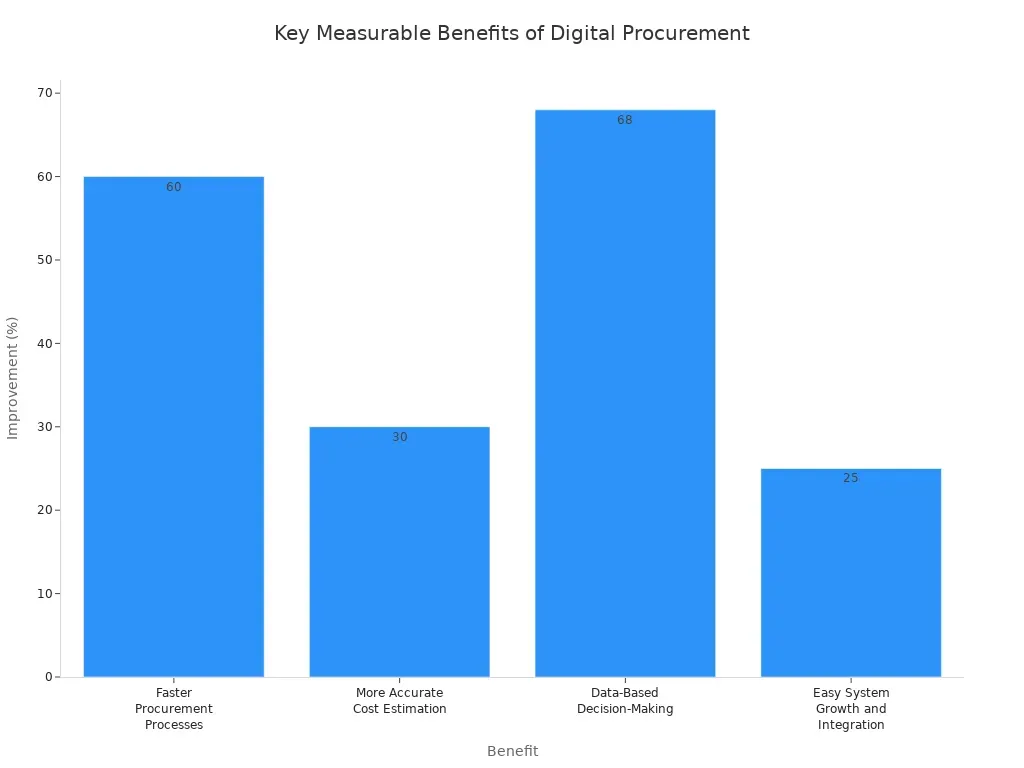
When you use Sibolla Building’s solutions and B2B platforms, you get faster buying, better supplier relationships, and more correct cost estimates. You also make better choices with real-time data. This way helps you grow and change as your projects do.
Tip: Check your current process and try digital tools for your next project. You will see better results and feel less stress.
You can use Sibolla Building and B2B platforms to make buying easier. These tools help you spend less money and avoid problems. They also help you finish your projects on time. Picking the right model gives you more control or more freedom. To get the best results, you should:
- Centralize your buying to stop mix-ups.
- Buy in bulk to save money and earn more.
- Make supplier management simple for smoother work.
- Use real-time data to plan inventory and cash flow.
You can start by talking to Sibolla Building or trying digital tools for your next project.
FAQ
Centralized procurement means one team buys all materials for every project. This helps you control spending and follow the same rules. You can also save money by buying in bigger amounts.
Decentralized procurement lets each project team buy their own materials. Teams can pick local suppliers and act fast when things change. This model gives teams more freedom to make choices.
B2B platforms let you find, order, and track materials in one place. You can see all your orders and suppliers on one screen. This saves time and helps you make fewer mistakes.
Sibolla Building gives you everything you need for your project. You work with one team from start to finish. They help you plan, design, and deliver materials on time.
Yes, you can use both models at the same time. Many companies do this with a hybrid model. Central teams set rules and big contracts, while local teams buy what they need fast.
Real-time data shows you where your materials are right now. You can fix problems before they cause delays. This helps you make smart choices for your project.
Sibolla Building gives you direct factory access and custom solutions. You get better prices, good quality, and one team to help you. They support you through the whole project.
You can visit Sibolla Building’s website or contact their team. They will help you plan your project and pick the best solutions.